
The perils of cynicism
By assuming the worst of human nature, cynics opt out of the trust that's essential for their own happiness and a functioning society.


If seeing veteran 60 Minutes journalists fired for speaking truth to power doesn't make you cynical, these next two stories might.
The first is from the data center industry, where investors have been spreading claims that opponents to the centers are being financed by China. Canadian Kevin O'Leary, an investor in the massive Utah data center Stratos, didn't stop there: He called local organizations that have voiced their opposition "cells," implying they are local shills for the Chinese government. In a Fox News interview he posted on May 11 O'Leary name-checked the nonprofit Alliance for a Better Utah, progressive political consulting firm Elevate Strategies and individual staff members as well.
Hustling to investigate, journalists and researchers have found little to suggest widespread Chinese influence in the public outcry against data centers. There is a kernel of truth – several accounts that are likely Chinese were banned by OpenAI for creating inauthentic content about the environmental effects – but their impact was limited and direct ties to Chinese government, not apparent under scrutiny.
The organizations' leaders said the claims were outrageous and were stumped as to how they'd become the target of the former Shark Tank personality and his firm, O'Leary Digital. Alliance communications director Elizabeth Hutchings said O'Leary named people who were no longer employed there and financial sums that far exceeded the organization's operating budget. "The only foreign interest in this data center is Kevin from Canada," read an Alliance press release. "It’s insulting to Utahns across the state to say that any opposition or protest to this data center is the work of a foreign government." Read more in this June 10 piece from NPR's Morning Edition.
Another example of powerful people manipulating information to serve their interests came in January, when a photo circulated of St. Paul civil rights attorney Nekima Levy Armstrong, who was arrested by the Department of Homeland Security and the FBI for protesting at a church service. The image depicted her hysterical and disheveled as she was led away in handcuffs.
On January 22, the Guardian broke the story that the photo, which was posted on the White House X feed, was doctored.
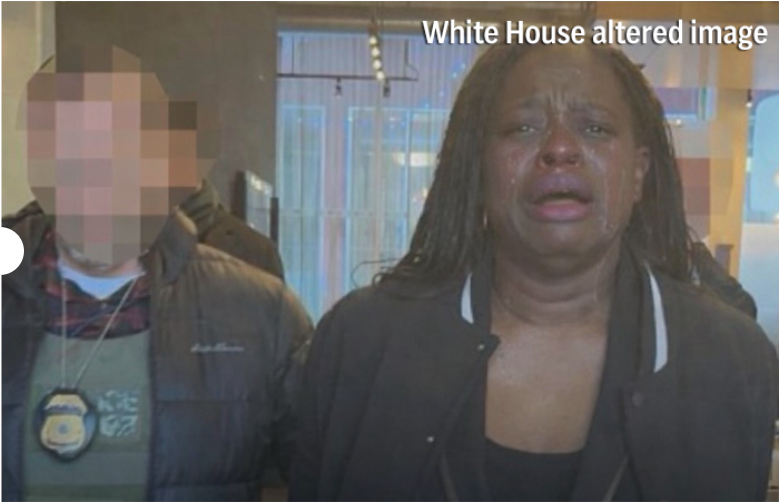
Armstrong, a 49-year-old mother of four, had in fact walked to the county jail with her head held high.
We use the ABCD framework to get to the root of these efforts. In this case:
- The Actor who doctored the photo is unknown;
- The Behavior was to create an image that suggests that jailed protestors are afraid and distraught, ostensibly to scare other protestors into silence;
- The Content was a manipulated image; and
- The Distribution channel, sadly, was the White House's X (Twitter) feed.
What made this example so blatant – and easy to dissect by standards-based journalists, or really anyone – was that then-Homeland Security Secretary Kristi Noem had shared the original, authentic photo of Armstrong 30 minutes prior to the White House post. In it, her face is expressionless.
For the full story, see this AFP News Agency video (@AFP on YouTube) or Associated Press article, which includes a slider that allows you to compare the original and doctored images.
Last chance to take our survey!
Are you currently working in adult media literacy education, do you know someone who is, or do you simply want to see more of it in our communities? Truth in Common is researching and assessing the current state of adult media literacy education in the United States and we would love to hear from you! Please take a moment to fill out this survey -- it was set to close yesterday but we'll keep it open for you. The team for this project includes Truth in Common founder Deanna Troust, media literacy educator Michelle Ciulla Lipkin and recent Brooklyn College graduate Sofia Canonge. Thanks in advance for your insights!
Understanding cynicism
Sharing AI-manipulated images and spewing falsehoods few will vet is commonplace now. We see the throw-up-your-hands effect it creates in every talk and workshop we host: People are losing faith and seeking alternative sources. Digital algorithms go to work and may produce more manipulated and misleading content, not less.
Folks' cynicism is understandable – but is it healthy or productive?
Stanford psychologist Jamil Zaki refers to this cycle as the "cynic's trap." In an episode of the excellent The Gray Area podcast, he challenges the widespread cultural assumption that cynicism represents hard-earned wisdom or courageous truth-telling. Host Sean Illing and he dig into why cynicism has become so pervasive in modern life and how it masquerades as sophistication, while actually distorting our perception of other people and the world around us.


Merriam-Webster defines cynicism as the practice of being a perpetual critic and fault-finder. Hard-core cynics may see people as inherently selfish, greedy, and dishonest – and that even altruistic actions are secretly driven by selfish motives.
Zaki, who's the author of Hope for Cynics: The Surprising Science of Human Goodness, says that cynical takes tend to be factually mistaken — people are more cooperative and trustworthy than cynics believe — and are also actively harmful to the cynics themselves, corroding their mental health, relationships, and capacity for engagement. Research suggests that cynics tend to earn less money, suffer from more health issues, and experience lower relationship satisfaction than non-cynics.
By assuming the worst of human nature – and by extension, the institutions we rely upon – by default, cynics create a self-fulfilling prophecy, opting out of the social cooperation and trust that are essential for both personal happiness and a functioning society.
A way out
Zaki proposes hopeful skepticism as a healthier, more grounded alternative. He distinguishes the two by noting that while a cynic has already reached a conclusion (e.g., everyone is selfish), a skeptic behaves more like a scientist. This mindset prioritizes active fact-finding and evidence-gathering before reaching a judgment. By treating social interactions as opportunities for data collection rather than foregone conclusions, individuals can update their beliefs based on reality rather than fear. This approach allows someone to remain critical of corrupt systems while staying open to the evidence of individual goodness.
Here are the specific exercises he recommends for becoming a "social scientist" in your own life and shifting toward hopeful skepticism:
1. Practice micro-trust
Cynics may preemptively distrust others to avoid being hurt or a "sucker." Zaki suggests taking small, calculated risks to see how people actually behave.
- The exercise: Identify a low-stakes situation where you can rely on someone—like asking a neighbor for a small favor or delegating a minor task at work without hovering.
- The goal: To gather real-world data that can contradict the cynical assumption that people will let you down.
2. Perform social fact-checking
Cynicism tends to be rooted in fear rather than evidence. Zaki suggests treating your negative assumptions as hypotheses rather than facts. Assuming positive intent in a given situation helps as well.
- The exercise: When you find yourself thinking, "They’re only doing that for the money," stop and ask: "What is my actual evidence for this specific person right now?"
- The goal: This forces you into a fact-finding mode, often revealing that your cynicism is a reflex rather than a reflection of the current situation.
3. Seek out bright spots
Because news and social media focus on outliers (the worst human behavior), our "data set" for humanity is now skewed.
- The exercise: Counter this trap by reading stories of cooperation or noticing small acts of kindness in public.
- The goal: To rebalance your internal narrative about how the average person or institution operates, making your worldview more accurate and less biased toward the negative.
4. Engage in positive gossip
Cynicism thrives on shared negativity. We often bond with others by complaining or criticizing a third party.
- The exercise: Make a conscious effort to tell someone else a story about a third person’s competence, kindness, or integrity. Same goes for institutions like the media sector or your local government.
- The goal: To change the social environment around you by encouraging others to also share evidence of goodness rather than just venting about flaws.
Eschew cynicism
(I confess I use the word "eschew" with thoughts of my high school AP English teacher, who always said "Eschew obfuscation." Anyway.)
You can refuse to fall into the whirlpool that is perpetual cynicism. The benefit: No more alienating others, losing faith in people and reality, or stifling joy in your life. Imagine that!
We'll close with an interesting take that may seem contradictory, but really isn't. Vietnamese Buddhist monk and peace activist Thích Nhất Hạnh speaks to the additional importance of remaining in and trusting the moment, rather than catastrophizing or clinging to hope, which suggests the current moment is inadequate. +1 on the "tomorrow will be better" mantra:
In other news
- This year's wave of election denials has begun. (Bogus Evidence Cited as Proof That California Elections Were Rigged Against Republicans, NewsGuard, June 9, 2026).
- Amid the fuss about the SpaceX IPO creating the world's first trillionaire are some special circumstances consumers should note: This IPO reserved up to 30 percent of shares for individual investors, versus the fraction that's typical. And the NASDAQ-100 relaxed its rules to make it easier and faster for SpaceX to be included in the index. (Want to invest in SpaceX? Here's what to know ahead of its IPO, New York Times gift article, June 10, 2026)
- My take: I get the shared wealth opportunities here but one must ask why those measures were in the mix. To me it seems destined to cement a system of unstoppable power that we're not equipped to handle. For example, I anticipate that all those investors will be pushed to X (Twitter) for updates – allowing Musk, who has the highest follower count globally and can affect public opinion with one re-tweet, to share his often-partisan and misleading takes with them directly. An already indebted group of shareholders will be that much more receptive to his viewpoints. It's legal, yes, but wildly unethical for the leader of a prominent communications platform.
- Indicator's Craig Silverman posed as a job searcher to reveal a sophisticated North Korean hiring scam. While interview candidates did a live coding test, scammers mined their passwords and crypto wallets. (I got inside a North Korean hiring scam. What I found reveals a troubling shift in tactics, Indicator, June 10, 2026)
- NewsGuard revealed that Iran state media – and in turn, leading AI chatbots – are spreading a slew of false claims about the war there. (Iran goes on a disinformation offensive and AI chatbots get lots in the fog of war, NewsGuard, March 5, 2026 and June 8, 2026)
- This handy guide from Digital Democracy Institute of the Americas and Factchequeado offers tips for organizations that engage Latino audiences increase the "stickiness" of their messages.
Follow us on Instagram @truth_incommon
LinkedIn | Threads: @dtroust | Twitter
Our mailing address is P.O. Box 21456, Washington, DC 20009
Copyright (c) 2024 Truth in Common. All rights reserved.