
Were these bloopers authentic, or a scheme?

Of all the norms that have been broken in 2025, here's one that's wild but hopefully less likely to induce a stress response than some others.
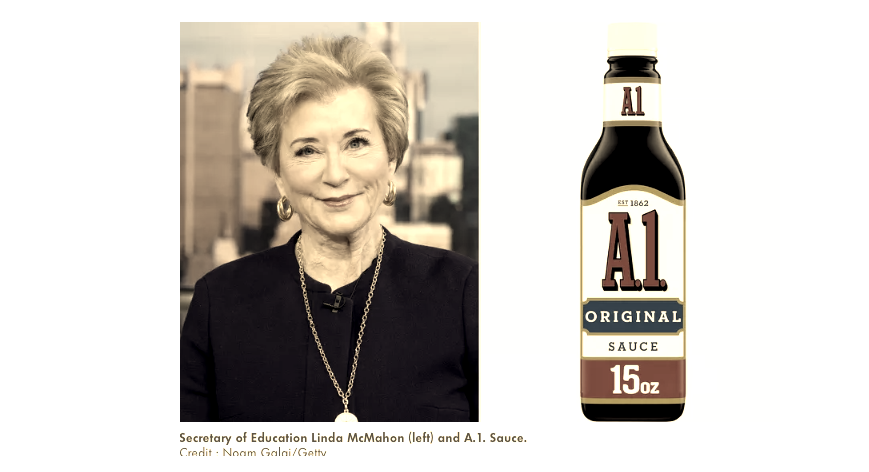
You may recall an incident last April when a widely circulated clip showed U.S. Secretary of Education Linda McMahon mistakenly referring to “A1” (“A one”) rather than AI ("A eye") at a conference in San Diego. Media outlets and pundits went nuts and the story tied up the news cycle for days.
But what if it wasn’t a mistake at all?
Our holiday gift to you is a story about steak sauce, cold soup and the lengths to which people will go to command our attention.
Support our end of year campaign!
For my birthday on Thursday (yes, Christmas Day), I'd love to see if we can achieve our Giving Tuesday fundraising goal. We're $835 short – can you help? Thanks so much, appreciate those who've already given and the best of the holiday season to you 🥳! – Deanna
Traditionally leaders have worked hard to avoid making mistakes in public for fear of embarrassment, blow-back or reputational damage. In recent years that convention appears to have been turned on its head.
Here's a video clip of Secretary McMahon's gaffe — check it out.
The transcript shows she referenced AI correctly in one sentence and incorrectly in the next:
“You know, AI [A-eye] development — I mean, how can we educate at the speed of light if we don’t have the best technology around to do that? I heard … that there was a school system that’s going to start making sure that first graders, or even pre-Ks, have A1 [A-one] teaching in every year, starting that far down in the grades. That’s a wonderful thing!”
Speculation alert 🤨
Journalists like MS Now's Rachel Maddow were quick to scoff at McMahon for being out of touch and unable to spell. But can it be that with AI on our tongues constantly, and at an EdTech conference co-sponsored by Global Silicon Valley, the top leader in American education said “A one" by accident? After she said it properly just a moment before, and while showing clear support for AI in schools?
Common sense would say it's doubtful. Linguistic analysis would say it's unlikely; as we'll explain, that's just not how slips of the tongue work. Let's explore.
Feeding the algorithm
The first thing to note is the context for the statement. Digital algorithms love drama and politics gives us plenty of opportunities for that. In a polarized environment, here's how virality can happen:
- People on the political left, and some media outlets, see a well-circulated clip of Secretary McMahon’s gaffe, or related news articles on social media, and read/engage/share, perhaps alluding to her intelligence or suggesting she’s a technical luddite;
- Right-leaning viewers amplify the commentary and clip, which is short and shows the mistake vs the moments prior, to cast liberals and media as nasty elites mocking a trusted figure who simply made a mistake;
- Influencers on both sides offer their own takes, giving the story even more traction and driving further engagement; and
- Algorithms serve all this content to more people.
Viewers' biases either for or against McMahon and the administration play a key role throughout the above sequence.
In all the articles we read about this incident, journalists took the comment at face value rather than saying wait a minute – was that for real?
What does linguistics tell us?
There are terms for common verbal mistakes. Transposing the consonants at the beginning of two words – saying "caking a bake" rather than "baking a cake" – is called a spoonerism, named for clergyman and Oxford dean William Archibald Spooner, who was famous for doing so. Freudian slips are when you make a mistake that appears to stem from your subconscious, like calling your new husband your last boyfriend's name. A mondegreen is when your brain replaces a word or phrase in a song or poem with what it thinks it hears, or what it wants to hear – like when you mishear music lyrics. This explainer video by Babbel.com mentions a mondegreen mistake I made for years: Thinking Taylor Swift says "got a lot of Starbucks lovers" instead of "got a long list of ex-lovers" in her song Blank Space. "Mondegreen" was coined in 1954 by American author Sylvia Wright, who heard "Lady Mondegreen" rather than "laid him on the green" in a poem her mother read to her as a child.
The closest linguistic gaffe to McMahon's is called an eggcorn. This is when you say a phrase mistakenly because it sounds similar to the one you intend to say – for example, saying "all intensive purposes" instead of "all intents and purposes" or "eggcorn" instead of "acorn" (the origin of the term.) But "A one" and "A eye" don't sound the same, and again she said it properly just moments before.
So with an awareness of the attention economy and after this brief linguistic analysis, one must at least consider the chance that the situation was planned; scripted by someone limited understanding of the verbal mistakes people actually make in order to win our collective attention. We may never know the truth, but we can see in the search returns that the goal was achieved in spades. While McMahon took a mild hit, the real winner was her community on the political right, which from the extensive commentary about the situation gained real-time proof of one of their main claims – that people on the left feel only disdain for them, their leaders and their ideologies – as well as some satisfaction that so many took it at face value.
Marketing gold
Here's the part for dinner table banter: A1's response. Quick to leverage the situation, the brand posted an altered image of the bottle on Instagram: "You heard her. Every school should have access to A.1."

Commenters then stepped up with clever takes in what became an unexpected viral moment for a well-known product.
As Occam's Razor would suggest. maybe this was simply about gifting a moment of notoriety A1 and its parent company, Kraft Heinz.
Read more here:
- Steak sauce brand A1 has hilarious response after Secretary of Education confuses "A1" for AI (People, April 14, 2025)
- Linda McMahon just handed A1 steak sauce an unbelievable opportunity (Fast Company, April 11, 2025).
Another example
McMahon's comment is not the only time we noticed a suspicious viral mistake. Watch this one, by Representative Marjorie Taylor Greene in 2022:
Just to clear things up, @RepMTG
— Republican Accountability (@AccountableGOP) February 9, 2022
Gazpacho: a vegetable-based Spanish cold soup
Gestapo: Nazi Germany's secret police pic.twitter.com/T9q76r706G
Saying "gazpacho" instead of "gestapo" (the secret Nazi police force) – hmmm. This error is even less subtle than McMahon's, doesn't fit the linguistic mistake categories above either and so seems even more obviously to have been designed to spark the mock-and-mock-back viral pinball.
Bless the Guardian for having some fun with it in this headline from February that year: 'Gazpacho police': Nazi gaffe lands Republican congresswoman in the soup.
What do you think?
Bloopers or schemes? Let us know what you think. Above all, we suggest some healthy skepticism when you see these incidents online or on TV.
In other news
- The Post exposed ICE's media tactics in a fascinating piece yesterday. The lede speaks for itself: "For the Immigration and Customs Enforcement public affairs team, the nighttime operation across metro Houston in October was a gold mine." ('It's a war' Inside ICE's social media machine, gift article from The Washington Post, December 22, 2025)
- On December 10, Australians under 16 lost access to 10 social media apps – Facebook, Instagram, Threads, TikTok, Twitch, Snapchat, YouTube, X, Reddit, and Kick – and these platforms have to take "reasonable steps" to prevent them from signing up going forward. Other countries issuing or contemplating bans include Malaysia, Denmark, Norway and the EU; some EU countries are testing age-verification apps as well. (Australia kicks the kids off social media, Platformer, December 8, 2025)
- In August, Bluesky went offline in Mississippi due to that state’s social media ban for users under 16. (Bluesky goes dark in Mississippi over age verification law, Wired, August 22, 2025)
- Last week ByteDance, TikTok's Chinese owner, said a deal had been signed to turn majority control of its U.S. operation over to a group of U.S. investors that includes Oracle and private equity firm Silver Lake. Details about the financial terms, who will own the recommendation algorithm and whether the user experience will be comparable are still unclear. (TikTok deal may help avoid US ban. What does it means for users? USA Today, December 18, 2025)
- Some reminders of how messy X (Twitter) has gotten:
- X chatbot Grok spread an array of falsehoods about the man shown tackling one of the Bondi Beach gunmen in a viral video, saying in different posts that he was an Israeli hostage and an IT specialist named Edward Crabtree, and questioning the video's authenticity by telling users it was an old video of a man climbing a palm tree. (Grok is glitching and spewing misinformation about the Bondi Beach shooting, Gizmodo, December 14, 2025)
- In November X announced Grok Unhinged Mode with claims that the chatbot will now deliver "epic vulgar roasts." Wired reporters tried it out, with cringey results. (Elon Musk Said Grok’s Roasts Would Be ‘Epic’ at Parties—So I Tried It on My Coworkers, Wired, November 25, 2025)
- NewsGuard's Reality Gap Index came in at 47 percent in November, meaning nearly half of Americans surveyed believed at least one of three widely circulated false claims that month. The falsehoods included: 1) President Trump yelled at his cabinet to block the release of the Epstein files; 2) NYC Mayor-elect Mamdani walked back his promise of a $30 minimum wage and 3) the Charlie Kirk assassin trained in the French army. (Nearly Half of Americans Believe November’s Top False Claims, NewsGuard, December 17, 2025)
- In an interview on the Hard Fork podcast that some gaming industry reporters called "unhinged" and "bizarre," Roblox CEO David Baszucki expressed frustration with repeated claims that users have been exposed to child predators and violent content. Parents should beware. (Roblox is a problem — but it’s a symptom of something worse, Platformer, November 24, 2025)
- Just days after X just launched its new geolocation feature, researchers found that falsehood-spreading accounts that say they're based in the U.S. are actually based overseas. Some claim to be fan accounts for figures like Barron Trump or the late Charlie Kirk. (Influential 'U.S.' accounts spread false claims from abroad, NewsGuard, November 24, 2025)
Follow us on Instagram @truth_incommon
LinkedIn | Threads: @dtroust | Twitter
Our mailing address is P.O. Box 21456, Washington, DC 20009
Copyright (c) 2024 Truth in Common. All rights reserved.